How FHA and Down Payment Assistance Are Keeping First-Time Buyers From Getting Priced Out
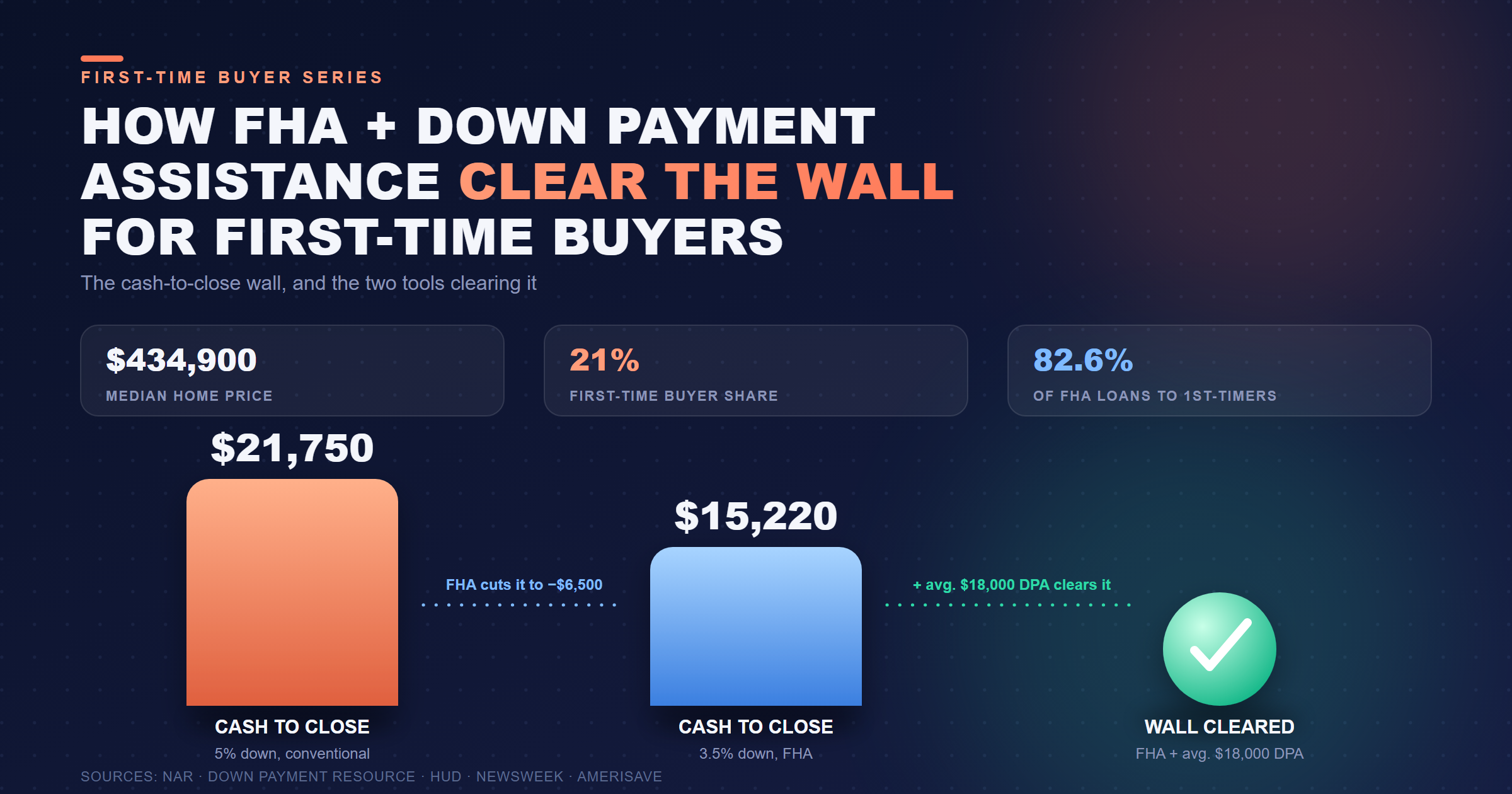
First-time buyers just made up 21% of home purchases — an all-time low. The median home price is now $434,900. Even at the conventional minimum of 5% down — the standard most first-time buyers are quoted when they walk into a conventional loan — that's still real cash due at the closing table.
Do that math and you're looking at roughly $21,750 in cash just to get to the closing table on a median-priced home. Most buyers I talk to don't have that sitting in a savings account. Most buyers don't have that saved anywhere.
That gap is exactly the problem FHA loans and down payment assistance programs were built to close. Used separately, they help. Used together, they're the reason a meaningful share of first-time buyers are still in this market at all instead of watching it from the sidelines.
The Math That's Actually Locking People Out
It's not really the mortgage payment that keeps first-time buyers out of the market anymore — plenty of people can afford a monthly payment close to what they're already paying in rent. It's the wall of cash due at closing.
At a 5% down payment — the conventional minimum — on that $434,900 median home, you're saving roughly $21,745 before you even touch closing costs. National data now shows it takes the typical buyer about seven years to save a full down payment — and that's a national average. In expensive metros, that number gets absurd fast; some households are looking at multiple decades to save enough the traditional way.
Seven years of saving while rent climbs and home prices climb faster isn't a plan. It's a treadmill.
What FHA Actually Solves
This is where the FHA loan does its job. Instead of the conventional minimum of 5% down — or the 20% a lot of buyers still assume they need — FHA financing requires just 3.5% down with a credit score of 580 or better. On that same $434,900 home, that's about $15,220 instead of $21,745. It's a meaningful difference — roughly $6,500 less cash needed at closing — and for a buyer scraping together savings, that gap can be the difference between qualifying this year or waiting another year to save.
It's not a coincidence that 82.64% of FHA purchase loans in FY2024 went to first-time buyers. This is the program doing exactly what it was designed to do back in 1934: lower the cash barrier enough that a regular income and a reasonable credit history are enough to qualify, without needing a decade of savings first.
But 3.5% of a median-priced home is still over $15,000. For a lot of buyers, that's still the wall. That's where the second piece comes in.
The Trade-Off Nobody Mentions: Mortgage Insurance
Lower down payment options don't come free. You're trading cash-at-closing for mortgage insurance — and FHA and conventional loans handle that trade very differently.
FHA charges an upfront mortgage insurance premium (UFMIP) of 1.75% of the loan amount at closing, plus an annual MIP — typically 0.55% for most borrowers — folded into your monthly payment. Here's the part that catches people off guard: if you put down less than 10%, that annual MIP sticks around for the life of the loan. There's no equity threshold where it automatically falls off. The only way out is refinancing into a conventional loan once you've built enough equity.
Conventional loans work differently. Private mortgage insurance (PMI) on a loan with less than 20% down runs somewhere between 0.46% and 1.50% annually depending on your credit score and down payment size — and by federal law, it has to cancel automatically once your loan balance hits 78% of the home's original value, typically within 8 to 11 years of on-time payments.
Run that out over the life of a loan and the gap is real: PMI on a 5%-down conventional loan can total around $12,000 before it cancels, while an FHA borrower keeps paying MIP for the full term — a difference that can add up to $40,000 or more over 30 years on comparable loan amounts.
That doesn't make FHA the wrong choice. For a lot of buyers, getting in the door today at 3.5% down is worth more than saving on insurance costs a decade from now — especially in a market where waiting to save more just means chasing a higher price next year. But it's a trade-off worth understanding before you pick a lane, not after.
The Piece Most Buyers Don't Know Exists
There are 2,679 active down payment assistance programs operating across the country right now, and every single state has at least one. Most buyers I sit down with have never heard of a single one of them.
These programs aren't fringe or hard to find once you know to look — they're run by state housing finance agencies, city governments, counties, and nonprofits, and they provide an average benefit of about $18,000 toward a down payment or closing costs. Depending on where you live, programs range from a few thousand dollars up to $100,000 or more in high-cost markets like New York City, where the HomeFirst program offers up to $100,000 for qualified first-time buyers.
Here's how that assistance typically shows up:
• 56% are structured as second mortgages — a separate, usually low- or no-interest loan behind your primary mortgage
• 36% are deferred-payment seconds — no payments due until you sell, refinance, or pay off the home
• 8% are outright grants — money you never have to repay at all
How FHA and DPA Stack Together
Think of it like a two-part solution to the same problem. FHA lowers the height of the wall. Down payment assistance gives you the boost to clear what's left.
Run the numbers on that median $434,900 home: FHA financing brings the down payment requirement to roughly $15,220. The average down payment assistance benefit nationally is about $18,000. Stack those together and, in a lot of cases, the assistance doesn't just help with the down payment — it can cover it entirely, with room left for closing costs, which typically run another 3-6% of the purchase price.
That's the combination that's kept a real segment of first-time buyers in this market even as prices have climbed and the traditional 10-20%-down path has gotten further out of reach for most people saving the old-fashioned way.
What You Actually Need to Qualify
None of this is automatic, and it's worth knowing the fine print going in:
• Income limits are common. Many DPA programs cap eligibility around 80% of your area's median income, though a growing share — now 62% of programs — set that ceiling above $100,000, opening the door to more buyers than people assume.
• "First-time buyer" is usually broader than it sounds. Most programs define it as not having owned a home in the past three years, not literally never having owned one. If you sold a house five years ago, you likely still qualify.
• Availability is hyper-local. What's available in your county can be completely different from the next county over. This is not a one-size-fits-all national program — it's a patchwork, and that patchwork only works in your favor if someone actually walks you through what's local to you.
Why This Matters Right Now
First-time buyers dropping to 21% of the market isn't a minor statistic. It's a warning sign about who gets to build equity and who gets left renting indefinitely while prices keep moving. FHA and down payment assistance aren't a workaround for a broken system — they're currently one of the only functioning countermeasures keeping that door from closing entirely.
If you've assumed you need 10-20% down and years of saving before you can even start looking, that assumption is probably costing you time you don't need to spend. Ask your lender specifically what FHA and DPA options exist in your county before you make any decision about when you're "ready" to buy.
________________________________________
Sources: National Association of Realtors (median home price and first-time buyer share data); Down Payment Resource (active DPA program count and structure); HUD FHA-Insured Single-Family Mortgage Originations and Market Share Report; Newsweek (down payment savings timeline analysis); AmeriSave and Real Cost Report (FHA MIP vs. conventional PMI cost analysis).