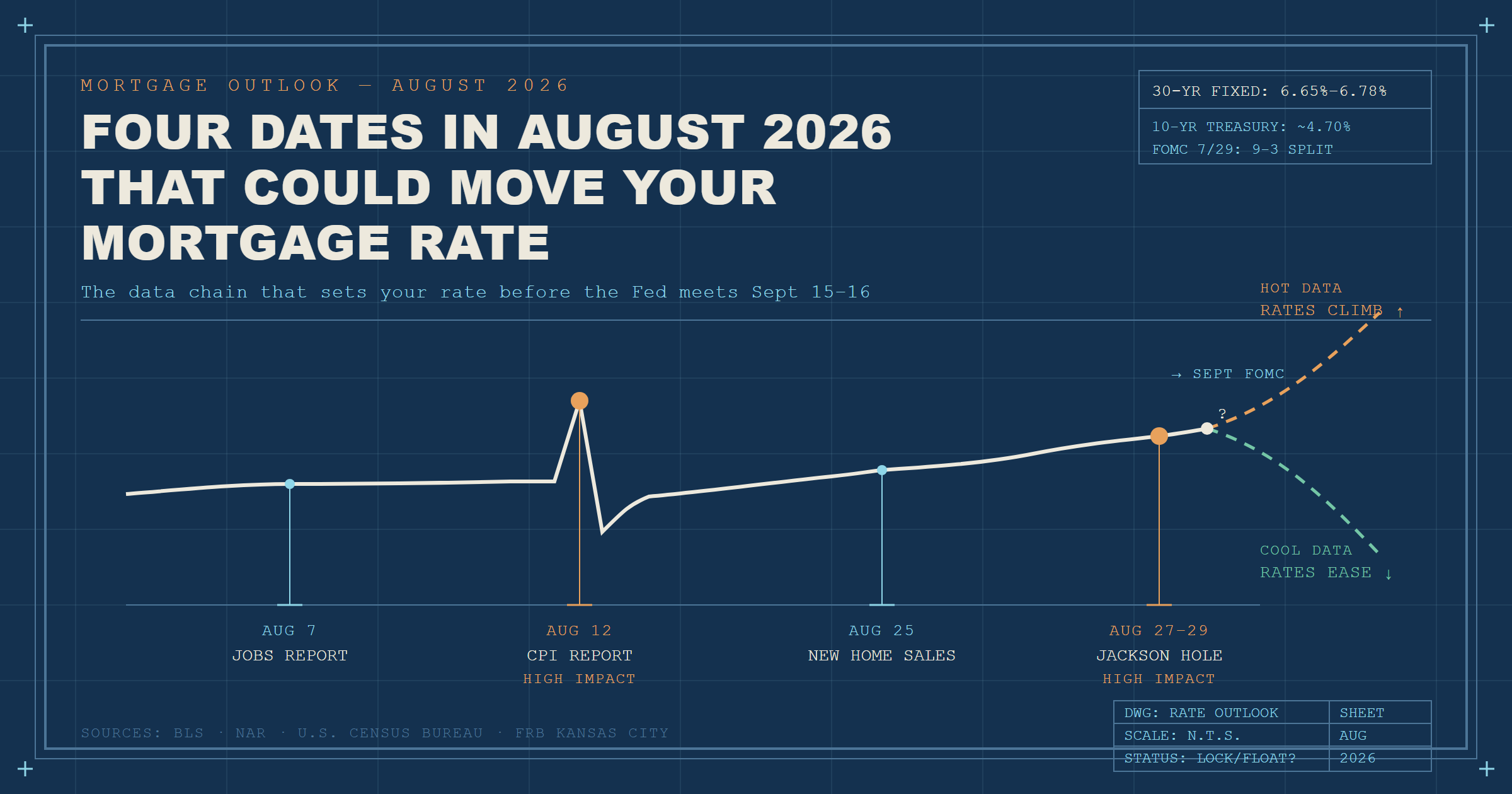
Four Dates in August 2026 That Could Move Your Mortgage Rate
Rates are sitting near a one-year high — 30-year fixed averaging around 6.65%–6.78%, with the 10-year Treasury yield near 4.7%. If you're watching the market wondering when relief might come, don't watch the calendar randomly. Watch these specific dates.
August is a loaded month. Four data releases and one closely watched speech will shape whether rates drift down before fall or grind higher. Here's what's actually on the calendar, and how each one could move what you pay.
August 7 — The Jobs Report
The Employment Situation report for July lands August 7. This is the single most-watched economic release every month, and it moves bond yields fast.
Here's the mechanic: a weak jobs number signals a cooling economy, which raises the odds of Fed rate cuts, which tends to pull the 10-year Treasury yield — and mortgage rates with it — lower. A strong, hot jobs report does the opposite: it tells the bond market the economy doesn't need help yet, and rates hold or climb.
Given the Fed's July 29 meeting ended in a genuinely split 9-3 vote, with three regional presidents pushing for a cut, this jobs report carries extra weight. It's one of the last major data points before the Fed's next meeting in September.
August 11 and 12 — Existing Home Sales and CPI, Back to Back
Existing-home sales for July post on August 11, giving a read on whether buyers are actually transacting at today's rates or sitting on the sidelines waiting for relief.
Then on August 12, the July Consumer Price Index drops — and this is the big one. Inflation is the root cause behind this year's rate climb. CPI hit 4.2% earlier in 2026, the hottest reading since 2023, and it's the reason bond investors have been demanding higher yields on long-term debt. If July's CPI comes in cooler than expected, expect a real rally in bonds and a corresponding dip in mortgage rates. If it comes in hot again, expect the opposite — and expect it fast. CPI days routinely move mortgage rates more in a single morning than a typical month of drift.
August 25 — New Home Sales
New residential sales for July round out the housing data for the month. This one matters less for rate direction and more as a temperature check: builders have been leaning on rate buydowns and incentives to move inventory in a higher-rate environment, and this report shows whether that strategy is working.
August 27–29 — Jackson Hole, and a New Voice at the Podium
This is the month's headline event. The Federal Reserve's annual Jackson Hole Economic Symposium runs August 27–29 in Wyoming, and the keynote — traditionally delivered Friday morning — is the single most market-moving speech of the year outside of an actual FOMC meeting.
This year carries extra significance: it's Fed Chair Kevin Warsh's first Jackson Hole address at the podium. Markets will be parsing every word for a signal on where he wants to take policy heading into the September 15–16 FOMC meeting. For context on how much these speeches can matter — Jerome Powell's Jackson Hole remarks in August 2025 opened the door to a September rate cut and moved markets immediately. A new Fed Chair's first major public framing of his approach to inflation and rates is the kind of event that can reprice the bond market within minutes of him speaking.
How These Connect: The Chain That Sets Your Rate
None of these events move mortgage rates in isolation. They build on each other:
Jobs data and CPI shape what the bond market expects the Fed to do. Jackson Hole is where the Fed Chair either confirms or pushes back on those expectations. The September FOMC meeting is where it becomes official policy. Your mortgage rate reacts to each link in that chain — not just the final decision three weeks from now.
What This Means If You're Buying or Refinancing This Month
If you're shopping for a rate in August, treat CPI day (August 12) and the Jackson Hole keynote (expected around August 28) as the two highest-risk, highest-opportunity moments on your calendar.
If you're rate-sensitive and closing soon: consider locking before August 12. A hot CPI print could move rates against you same-day, and there's no upside to being unhedged going into a release that's historically this volatile.
If you have flexibility and time before closing: it may be worth floating through Jackson Hole. A dovish signal from Chair Warsh — especially paired with a cooler CPI reading earlier in the month — is the most plausible path to meaningfully better pricing before fall.
Either way: talk to your lender about a float-down option now, before these dates hit, not after. That's the tool that lets you lock in downside protection without giving up the chance at a better number if the data breaks your way.
Rates will move on data this month — that part's certain. Which direction depends on numbers nobody's seen yet. Position yourself so you're not scrambling on August 12 or August 28 trying to figure out what just happened to your rate.
Sources: Bureau of Labor Statistics (Employment Situation and CPI release schedules); National Association of Realtors (Existing-Home Sales schedule); U.S. Census Bureau (New Residential Sales schedule); Federal Reserve Bank of Kansas City (Jackson Hole Economic Symposium); Federal Reserve FOMC meeting schedule.