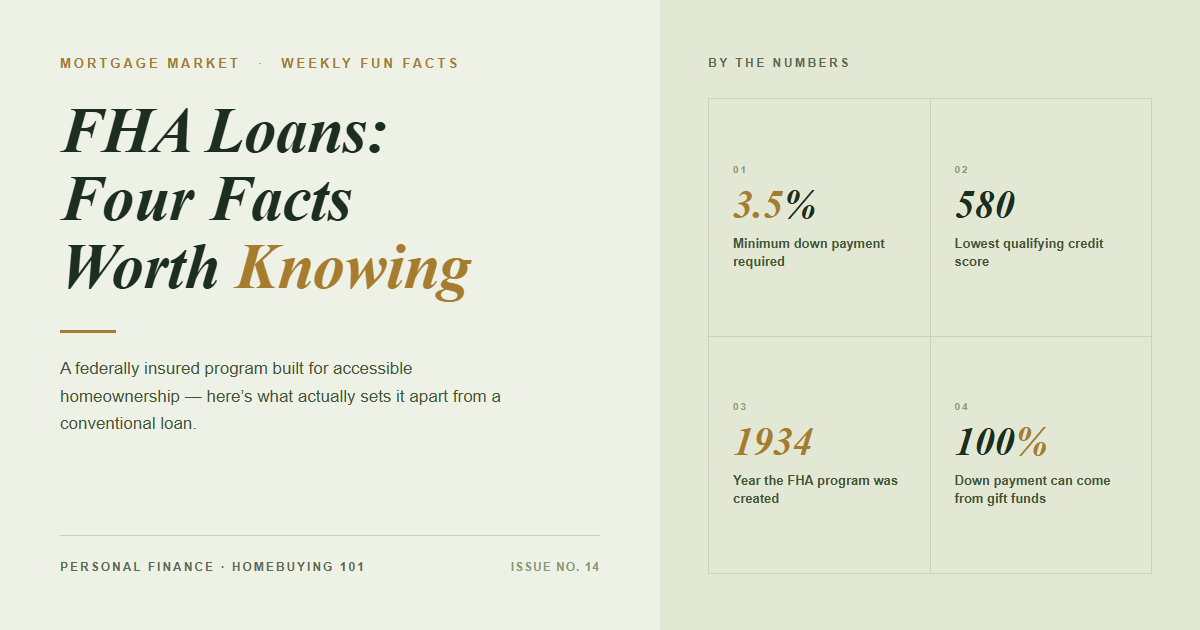
Sunday Funday Mortgage Facts: The FHA Loan Is 92 Years Old and Still Running the Show
Every Sunday I dig into a piece of mortgage history that actually matters. This week: the FHA loan — the program most first-time buyers use without knowing why it exists.
Quick trivia question before your coffee kicks in: what do 1 in every 5 homebuyers today have in common with a family buying a house during the Great Depression?
They're both leaning on the same federal program. It's just gotten a lot better at its job.
The Backstory Nobody Tells You
Picture the mortgage market in 1933. You want a house? Good luck. You needed 50% down. The loan term was three to five years — not thirty. And at the end of it, you owed one giant balloon payment for whatever was left. Miss that, and the bank took the house.
Only 1 in 10 American households owned their home. Not because people didn't want to. Because the math didn't work for regular families.
Then, on June 27, 1934, FDR signed the National Housing Act and created the Federal Housing Administration. Here's the part that's easy to miss: the FHA never lent anyone a dollar. What it did was insure the loan for the bank — so if a borrower defaulted, the lender didn't eat the loss. That one guarantee is what convinced banks to start offering the 20- and 30-year amortizing mortgage we all take for granted today. The FHA didn't just help people buy homes. It invented the modern mortgage.
The Numbers That Still Stop Me
Between 1934 and 1972, the FHA helped nearly 11 million families buy a home and another 22 million improve the one they had. Over that same stretch, the U.S. homeownership rate climbed from 44% to 63%.
Zoom out to today: the FHA has insured more than 50 million home loans since that 1934 signature. Fifty million families who got the keys because a government insurance program made a bank comfortable enough to say yes.
Where FHA Stands Today — Still Doing Exactly What It Was Built For
Ninety-two years later, the mission hasn't drifted. FHA loans exist to get first-time and lower-down-payment buyers into homes conventional financing might turn away. The numbers back that up: in FY2024, 82.64% of FHA purchase loans went to first-time homebuyers. This isn't a niche program. It's the front door for the vast majority of people buying their first house with FHA financing.
In 2025, FHA-insured mortgage volume hit $1.583 trillion — the fourth straight year the program's market share has grown. In a year when overall lending tightened, FHA didn't shrink. It grew.
Here's what qualifying looks like right now:
• 580 credit score or higher: 3.5% down payment
• 500–579 credit score: 10% down payment
• 2026 loan limit floor: $498,257 in most counties, higher in expensive markets
Compare that to 1933's "50% down, five years, balloon payment," and you start to appreciate what this program actually solved.
Three FHA Facts That Make Great Trivia
1. FHA loans are assumable. In a world where 30-year rates are sitting near 6.65%, this is bigger than it sounds. If you sell a home with an FHA loan, the buyer can potentially take over your existing rate and terms instead of getting a brand-new loan at today's number. A homeowner with a 2021-era 3% rate holding an assumable FHA loan is sitting on real leverage in a negotiation.
2. There's a version built for fixer-uppers. The FHA 203(k) loan lets you roll renovation costs into your mortgage — so buying a house that needs a new roof or kitchen doesn't require a separate construction loan on top of your purchase loan.
3. Refinancing can be almost paperwork-free. The FHA Streamline Refinance skips a lot of the standard documentation and, in many cases, doesn't even require a new appraisal — built specifically to make it easier for existing FHA borrowers to improve their terms.
The Takeaway
The FHA loan wasn't built to be flashy. It was built to solve a specific problem — regular families getting locked out of homeownership by loan terms that only worked for the wealthy — and it's been solving that same problem, quietly, for 92 years.
If you've got a lower credit score, a smaller down payment, or you're buying your first home and conventional financing feels out of reach, this is the program worth asking your lender about first. It was designed for exactly that moment. It still is.
________________________________________
Sources: HUD.gov FHA History; National Housing Act of 1934; FHA.com loan requirements; HUD FHA-Insured Single-Family Mortgage Originations and Market Share Report.