Why Home Purchase and Refinance Rates Keep Climbing in 2026 — And What's Really Driving It
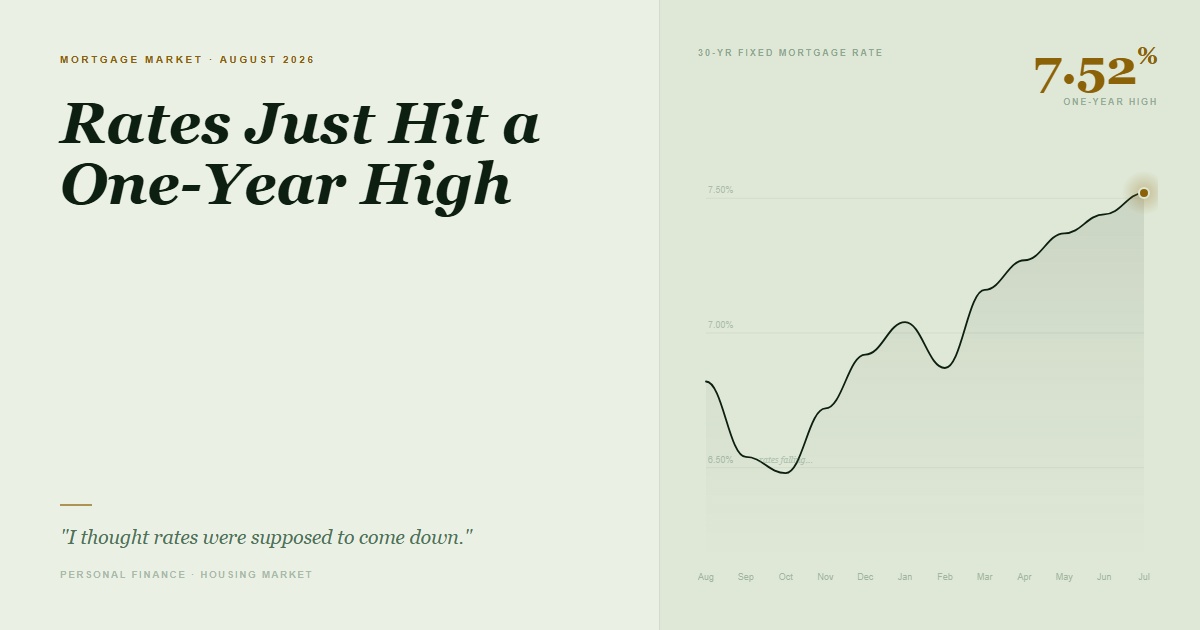
Mortgage rates just hit their highest point in a year, and I've had the same conversation with a dozen people this month — buyers and homeowners alike: "I thought rates were supposed to come down."
They were. That's not what happened.
As of this week, the average 30-year fixed mortgage rate is sitting around 6.65%–6.78%, depending on the source, with Freddie Mac pegging it at 6.66%. The 15-year fixed is hovering closer to 6.0%. Six months ago, most forecasters had 2026 rates trending toward the low 6s by summer. Instead, rates have gone the other direction three weeks running.
If you're house hunting — or sitting on a mortgage you've been meaning to refinance — that whiplash is confusing. So let's cut through it. Here's what's actually pushing mortgage rates and refinance rates up in 2026, why the Fed isn't the villain you think it is, and what it means whether you're trying to buy, lock a rate, or decide if now's the time to refinance.
Current Mortgage Rates and Refinance Rates: Where Things Actually Stand
30-year fixed (purchase): ~6.65%–6.78% national average
30-year fixed (refinance): typically runs a touch above purchase rates — lenders price refis slightly higher on average
15-year fixed: ~6.0%–6.01%
10-year Treasury yield: ~4.7%–4.74% (this one matters more than people realize — more on that below)
Fed funds rate: held at 3.50%–3.75% for the fifth straight meeting
That last number is the one most people assume controls mortgage rates. It doesn't — not directly. And that misunderstanding is where most of the confusion about "why are rates going up" starts.
The Fed Isn't Setting Your Mortgage Rate. The Bond Market Is.
Here's the analogy I give clients: think of the 10-year Treasury bond as a landlord deciding what rent to charge a long-term tenant. If the landlord believes prices are about to rise fast, they're not going to lock in today's rent for ten years — they'll charge more upfront to protect themselves against getting shortchanged later.
That's exactly what bond investors do with Treasury yields. Mortgage rates track the 10-year Treasury closely because both are long-term bets on where inflation is headed. When investors expect inflation to run hot, they demand a higher yield to compensate for the risk that their return gets eaten alive by rising prices. Lenders then price mortgages off that yield, plus a margin. Higher yield, higher rate. Every time.
So when the Fed held rates steady at its July 29 meeting — a genuinely split decision, 9-3, with three regional presidents dissenting because they wanted a cut — the bond market didn't relax. It got more nervous. Long-term yields moved higher after the announcement, not lower, because the split vote signaled the Fed isn't confident inflation is under control. That uncertainty is what dragged mortgage rates up with it.
Three Things Actually Driving Rates Higher Right Now
1. Inflation isn't behaving. CPI climbed to 4.2% earlier this year — the hottest reading since 2023 — driven in part by oil prices spiking on the back of conflict in the Middle East. Inflation has now run above the Fed's 2% target for more than five years. Bond investors price that persistence directly into long-term yields.
2. The Fed is stuck, and everyone can see it. Five consecutive meetings holding steady, and this last one nearly split down the middle. When the Fed itself is divided on whether to cut or hold, markets read that as "higher for longer" — and price accordingly.
3. The government is issuing a lot of debt. When Washington borrows more, it floods the market with Treasury bonds. Basic supply and demand: to get investors to absorb all that new supply, the government has to offer higher yields. Those higher yields flow straight through to what you pay on a 30-year mortgage.
None of these three factors are about your credit score, your down payment, or your local housing market. This is macro. It's happening to every buyer and every homeowner with a mortgage in the country at once.
What This Actually Means If You're Buying Right Now
Here's the part that doesn't get said enough: higher rates aren't the whole story on affordability.
The housing market has cooled alongside rising rates. Inventory is building. Price growth has slowed sharply from where it was a couple years ago. That's a real trade-off, and it's one worth understanding rather than panicking about.
A buyer locking a rate today at 6.65% instead of 6% on a $400,000 loan is looking at roughly $170 more per month. That's real money. But that same buyer today often has more room to negotiate, more inventory to choose from, and less competition than they would have faced in a lower-rate, higher-frenzy market. Rate and price are two levers on the same scale — when one goes up, the other tends to give a little.
If you're waiting for the "perfect" rate before you buy, understand what you're actually waiting for: you're betting on the exact same inflation and bond market forces we just walked through resolving in your favor, on your timeline. Nobody can time that with precision — not me, not your lender, not the Fed itself.
What This Actually Means If You're Thinking About Refinancing
If you locked your rate in the 3s or 4s, this isn't your moment for a rate-and-term refinance — and I'll tell you that straight instead of running your numbers for a deal that doesn't pencil out. A higher-rate environment doesn't change that math.
But "should I refinance" isn't only a rate question, and treating it like one is where people talk themselves out of a move that still makes sense.
A few scenarios where refinancing still holds up even with rates where they are:
You're on an ARM approaching adjustment. Locking into a fixed rate now, even at 6.6%, can beat riding an adjustable rate into an unknown reset — especially with the Fed's own outlook this uncertain.
You need to tap equity. A cash-out refinance to consolidate higher-interest debt, fund a renovation, or cover a major expense can still make sense even at today's rate, if the alternative is a credit card at 22% or a personal loan at 12%.
You're carrying PMI you could drop. If your home's value has climbed enough to hit 20% equity, refinancing out of mortgage insurance can offset a chunk of the rate difference.
You have a shorter time horizon in mind. Refinancing into a 15-year term to build equity faster, or restructuring a second mortgage, isn't primarily a rate-chasing move.
The one thing I'd tell every homeowner asking "is now a good time to refinance": run the actual break-even math — closing costs divided by monthly savings or benefit — before deciding based on a headline rate. That number tells you more than the rate itself does.
Where Rates Might Go From Here
Forecasters aren't predicting a return to 3% or 4% mortgage rates anytime soon, and anyone telling you otherwise is selling something. The realistic range being discussed:
Fannie Mae expects rates to ease toward roughly 6.3% by the end of 2026
MBA projects rates holding closer to 6.5% through the rest of the year
Translation: modest relief is plausible. A dramatic drop is not the base case. Rate cycles move in inches, not miles, and they move on inflation data and Treasury auctions — not headlines.
The Move That Actually Matters
Stop trying to predict the exact bottom — for either decision.
If you're buying: get pre-approved now so you know your real number, ask your lender about a float-down option in case rates ease before closing, and buy based on what the payment does to your monthly budget today — not what you hope it'll be in six months.
If you're weighing a refinance: don't let a headline rate make the call for you. Get your break-even number, look at your actual goal — cash out, drop PMI, escape an ARM, shorten your term — and decide based on that, not on where the 30-year average sits this week.
Rates are a variable you don't control. Your timing and your preparation are.
________________________________________________________________________________________________________
Sources: Freddie Mac Primary Mortgage Market Survey; Bankrate; Federal Reserve FOMC statement, July 29, 2026; Fannie Mae Economic and Strategic Research Group; Mortgage Bankers Association.